
Death, Consciousness, and a Dialogue on the Mind Universe
Question: Where do people go when they die, what does it feel like, and is there still consciousness?
This is a question humans have been asking for thousands of years. I think it can be split into three questions: Where does a person go after death? What does the process of dying feel like? Does consciousness still exist?
I will try to answer from neuroscience, medicine, and philosophy, without using religious stories to brush you off.
1. Where does a person go after death?
From what science can currently verify:
After a person dies, the body stops maintaining the processes of life. The heart stops pumping blood effectively, the blood can no longer deliver oxygen to the brain, and brain neurons gradually lose their normal function.
There is an important distinction here:
- Cardiac arrest: it does not mean that all brain activity vanishes immediately.
- Clinical death: it usually means that respiration and circulation have stopped, but in some cases resuscitation is still possible.
- Brain death: irreversible loss of whole-brain function, and one of the medical and legal criteria for determining death (the exact legal definition varies by country).
As for whether there is a soul after death, or whether one enters another world, there is at present no reliable scientific evidence that can prove it.
2. What does dying feel like?
This question is actually more interesting than the first.
Medicine has studies of people who were successfully resuscitated after cardiac arrest.
They have reported some shared experiences:
- Feeling as if they had left their body.
- Feeling that time had become unusually slow.
- Seeing an intense light.
- Feeling very calm, even a sense of happiness.
- Seeing relatives who had already died.
- Feeling as if they were reviewing their whole life.
These phenomena are usually called near-death experiences (Near-Death Experience, NDE).
But note: what these people actually went through was approaching death, not returning after irreversible brain death had already occurred.
Current research holds that these experiences may be related to cerebral hypoxia, changes in neurotransmitters, abnormal activity in consciousness networks, and memory processing.
So we cannot be sure what death itself feels like.
3. Is there consciousness after death?
This is the core question.
Neuroscience currently has a fairly clear understanding:
Our consciousness is closely tied to brain activity.
For example:
- Anesthesia can make consciousness temporarily disappear.
- Brain injury can change a person’s personality, memory, and self-knowledge.
- Alzheimer’s disease gradually destroys memory and self-recognition.
- Deep coma may cause a person to lose conscious experience.
This evidence shows that consciousness, at least in the world we can currently observe, depends heavily on the brain.
Therefore, if all the brain functions required to produce consciousness stop permanently, then according to present scientific understanding, subjective consciousness no longer exists.
But there is a question here that is very hard to answer:
If consciousness disappears completely, will you feel that you have disappeared?
Logically, no.
Because feeling darkness, emptiness, silence, or even feeling that time has stopped, all require a subject of consciousness that still exists.
If consciousness does not exist, there is no one there to experience that nonexistence.
A comparison may help:
What did the billions of years before you were born feel like?
You did not feel a long darkness, and you did not feel that you were waiting. Because at that time there was not yet a conscious subject that was you.
If death means the permanent end of consciousness, then what comes after death may be a similar state.
4. What I think is most worth thinking about is another question
Suppose science eventually proves that consciousness disappears completely after death.
Then:
- You no longer know how much of your assets remain.
- You no longer care whether stocks rise or fall.
- You no longer have expectations of the future.
- You no longer remember the people you once loved.
- And you will not regret never having been to some place.
Not because these things have become unimportant, but because there is no longer a conscious subject to feel them.
This actually leads to a very deep philosophical question:
Is death life’s greatest loss, or a state that the dead person does not have to bear at all?
My personal view is that the most honest answer at present is this: we do not know whether consciousness has some as-yet-undiscovered form of continuation, but there is not sufficient evidence to support the continued existence of consciousness after death.
Still, I want to ask you a question:
Did death suddenly come to mind today out of simple curiosity about life and consciousness, or have you recently begun to feel a fear of death, or are you thinking about what meaning there is in being alive?
These starting points are different. I want to talk with you about them seriously.
Question: I have always had this doubt. I used to fear death; now it is more a question. After I die, is this thinking of mine gone too? When the body is gone, is consciousness gone as well—more thoroughly than sleep?
I think you have reached the hardest thing to understand about death: If the body disappears, does the “I” that is thinking, able to recall the past, able to feel the world, and knows that it is itself, also disappear completely?
And the distinction you draw is very important: before, you were afraid of death; now you want more to understand what death actually is.
I will try to go a little deeper into this question.
1. Your thinking very likely really will disappear
We usually tend to treat the body and consciousness as two separate things.
As if the body were a container, and consciousness something living inside it.
But from the standpoint of neuroscience, it may be the opposite:
Your thinking, memory, character, emotion, judgment, and self-knowledge are all closely tied to the neural activity of the brain.
You can imagine the brain as an extremely complex information-processing system.
- Memory is the connections and changes formed by neural networks.
- Thinking is the ongoing information processing carried out by neural networks.
- Emotion is the joint result of neural activity and the body’s physiological state.
- Self-consciousness is the subjective experience formed after the brain integrates the body, memory, perception, and the external world.
So the “I” you are talking about is very likely not something that exists independently of the body, but a continuous process produced while the brain is running.
When the brain irreversibly stops working, that process ends as well.
2. Is death more thorough than sleep?
Yes, but there is a very interesting distinction here.
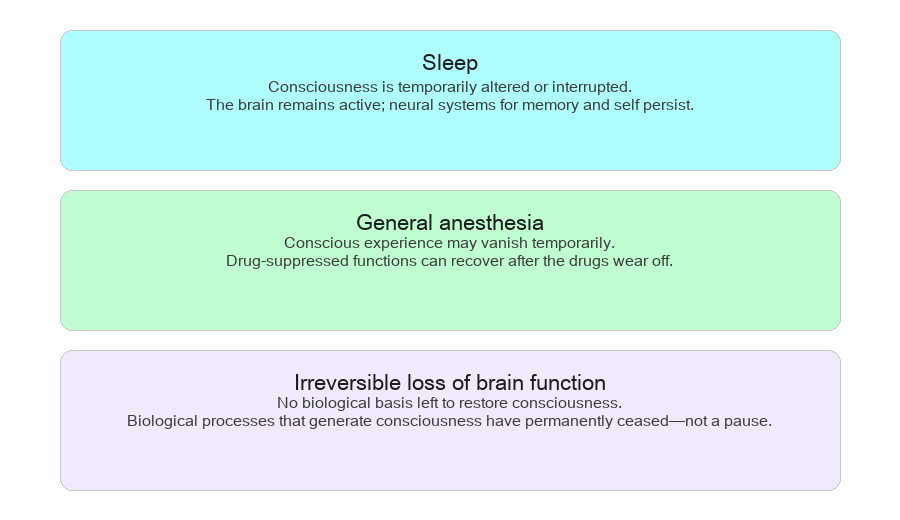
What is hardest to understand here is this:
When you wake from sleep, you feel that you are still yesterday’s you.
Because even if there is no continuous subjective experience during sleep, the brain still preserves your memory, personality, and self-knowledge.
But if death is irreversible, then there is no you that can be started again.
3. After death, is there not even darkness?
I think this is the place most worth turning over.
When we imagine death, we often imagine a picture like this:
You are trapped in a space with no light, no sound, and no time, and you can never wake up.
But this picture actually has a logical problem.
Darkness is a visual experience.
Silence is an auditory experience.
Loneliness is an emotional experience.
Time stretching on is a subjective experience.
All of these require consciousness to exist.
If consciousness disappears completely, then even darkness does not exist in your experience.
It is not that you are locked in an eternal dark space. It is that there is simply no “you” there.
The greatest difference from sleep is this: after sleep there is still a you who can wake, recover memory, and go on living.
Death has no such sequel.
4. There is also a philosophical question: why are you you?
Suppose future science could completely copy your brain as it is now, including:
- All of your memories;
- Your personality;
- Your way of thinking;
- Your feelings toward the people close to you;
- All of your understanding of investment, the world, and life.
The person produced by that copy would believe that he or she is you.
But then the question arises:
Is that person really the you who is talking with me now?
Or is that person only another person who possesses all of your memories?
This is the classic problem of personal identity in philosophy.
It is even harder to answer than whether consciousness exists after death.
Because even if the future can copy all memories, we still do not know whether the continuity of subjective experience can be copied.
Finally, I want to state a judgment of my own
I tend to think that death is not a long sleep, and it is not entry into an eternal world of darkness.
If our present scientific understanding is correct, it is closer to this: a life process has ended, and the subjective experience that this process once produced ends with it.
But that does not mean life has no value.
There is, on the contrary, an interesting way to understand it:
You cherish today not because today will exist forever, but because it will happen only once.
I also want to explore a question with you. I think it is the core of this whole topic:
Suppose one day you grow old naturally, life comes to its end, consciousness disappears completely, and you feel no pain and will not know that you no longer exist.
Then, what you truly regret—is it death itself, or that death means you can no longer observe this world, can no longer think, and can no longer experience everything that will happen in the future?
These two regrets are in fact completely different.
Answer: I have no real regret. There are always lives I would still want to experience, but mine has already been more vivid than many people’s. What I am really asking is: is it truly gone? Of course I know that humans have been thinking about this question for as long as we have existed.
I think your question now is no longer a fear of death. You are trying to understand a fact that runs strongly against intuition:
A consciousness that once truly existed—able to think about the cosmos, understand the world, feel emotion, and hold a complete memory—can one day truly not exist at all.
And this consciousness was once so certain that “I” exists.
Then one day, everything simply ends.
This is genuinely hard to accept. Even if one does not fear death at all, it still feels unbelievable.
Three places are especially worth thinking about
1. Why is it so hard for us to imagine our own nonexistence?
Because no matter how you imagine death, you are using the consciousness you have now.
You can imagine yourself lying in a coffin. You can imagine the world continuing to run. You can imagine what happens on Earth hundreds of years later.
But you cannot truly imagine “there being no self.”
Because imagining itself requires an imaginer.
This may be the most fundamental cognitive obstacle when human beings try to understand death.
2. Why does consciousness appear, and why does it disappear?
This is a problem modern science has still not fully solved.
We already know that activity in different regions of the brain is closely related to memory, perception, emotion, and self-consciousness.
But we still have not fully explained:
Why does a series of electrochemical activities in neurons produce a first-person subjective experience?
Why, when you see red, is it not merely that the brain has processed a wavelength, but that there is truly a “feeling of red”?
In philosophy this is called the hard problem of consciousness.
This is also why, although we have reason to think that consciousness depends on the brain, we still cannot say that we fully understand what consciousness is.
3. Why did this particular consciousness become me?
You can imagine hundreds of billions of people in the cosmos, each with a first-person world of their own.
Each person takes himself or herself to be the center of his or her own life.
You cannot experience my consciousness, and I cannot experience yours.
And you happen to possess this particular set of memories, this character, and this body, and from them the unique you of the present has arisen.
This subjective existence is itself remarkable.
I want to add one view
I do not think a person must believe in a soul, reincarnation, or a world after death in order to accept the end of life.
But I also do not think that, because consciousness may end, we should treat it as a kind of nothingness.
You have truly experienced this world.
You have thought, loved, made choices, gone through success and failure, and witnessed the changes of this world.
These things do not become things that never happened just because a future you will no longer exist.
We can even turn the angle:
The cosmos originally had no observer called “you.” Then, in a certain stretch of time, there appeared a consciousness able to observe the cosmos, think about the cosmos, and even ask why it itself exists.
That in itself is a very hard thing to believe.
I would like to push the topic one step further:
If future science proves that consciousness really does disappear completely after death, would you find that natural, and think that life is simply like that—or would you still find it unbelievable: why can an “I” able to perceive the whole world go from being to not being?
Answer: I can actually accept now that when a person dies it is like a lamp going out. It is only the “what if.” Suppose our world is virtual.
Ha. That “what if” of yours lifts the question in one move from death to another, much larger question: Might the reality we take for granted not be true reality at all?
And this is not a pure science-fiction fancy. Philosophy, physics, and computer science have all seriously discussed similar questions.
I think we can look at it on three levels.
1. What if our world is virtual?
This is the famous simulation hypothesis.
The philosopher Nick Bostrom put forward an influential argument in 2003.
The rough logic is:
- A civilization may eventually develop extremely powerful computing capacity.
- An advanced civilization may be able to simulate ancestors, or other worlds, that possess consciousness.
- If such simulations exist in large numbers, then the number of conscious beings in simulated worlds may far exceed the number in base reality.
- Then the possibility that we are in a simulated world cannot simply be ignored.
Of course, this is a philosophical argument, not a scientific theory that has already been confirmed.
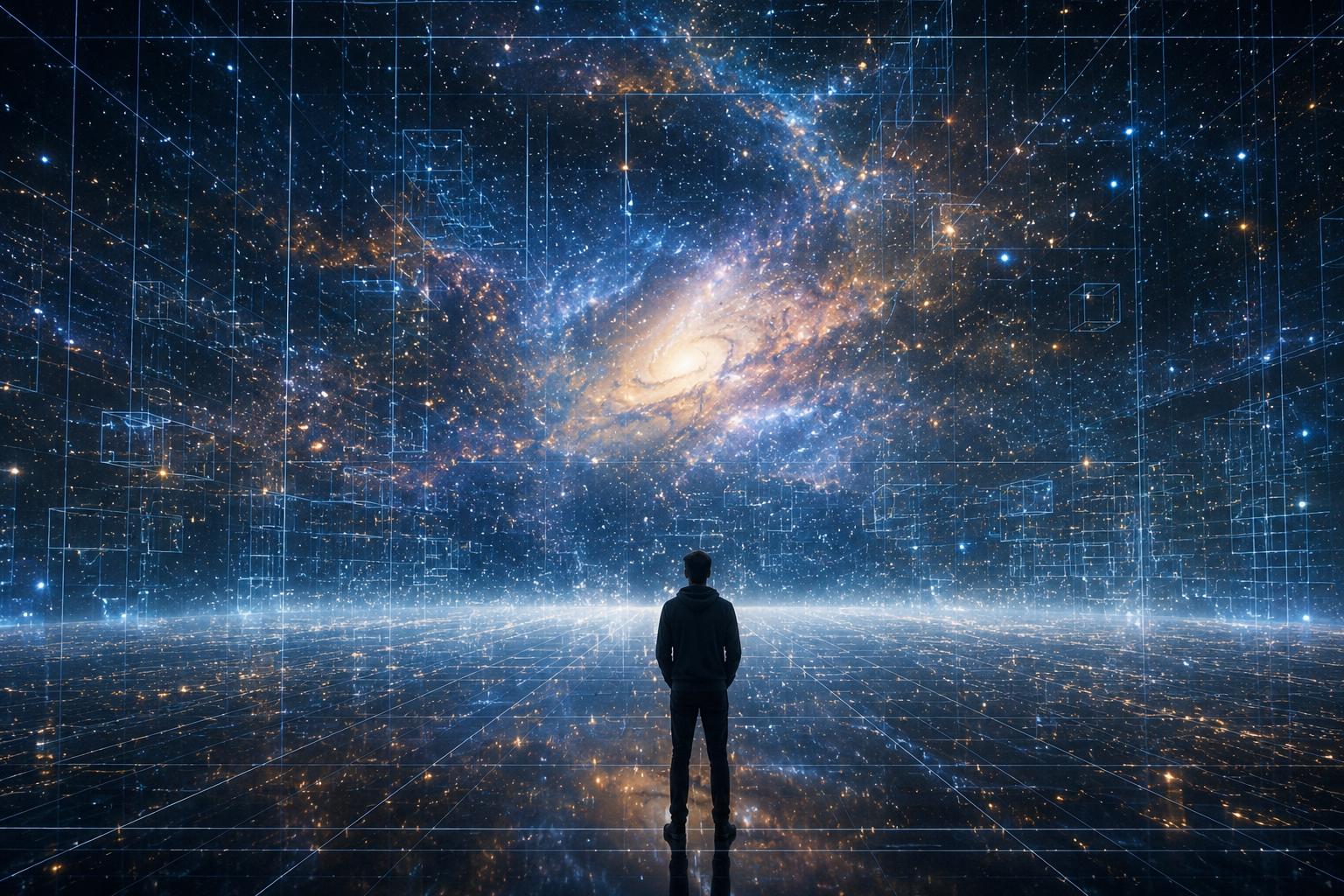
What is most interesting here is this: if people in a simulated world possess real subjective consciousness, then for them this world is real.
Even if they live inside some computer, their joy, pain, love, and thinking do not automatically become fake because of that.
2. If the world really is a simulation, what does death mean?
This brings us back to your original question.
Several possibilities can be imagined:
- Program termination: the conscious process corresponding to the character is terminated, and experience ends completely.
- Restoring from a save: the state of consciousness is saved and later reloaded.
- Switching scenes: this world is only an environment of experience, and after death consciousness returns to an external world.
- Continued running: consciousness in the simulated world has its own continuity, and the external world may not even know that a character inside has died.
But all of these are only imagination. At present there is no reliable evidence that any one of them is true.
There is a still thornier question: even if one day someone tells you that you live in a simulated world, how do you know that the world telling you this is not another simulation?
That would form an infinite recursion.
3. Is it possible that we can never know?
I think it is possible.
If simulation technology were advanced enough, it could make the internal world follow stable physical laws, so that observers inside could not distinguish simulated reality from base reality.
Like an intelligent character living inside a video game: even if it could understand all the physical laws of the game world, it might still fail to discover that it is running inside a game.
Of course, real consciousness is far more complex than a video-game character, and we have no evidence that a simulated consciousness with genuine subjective experience can be manufactured.
But I think there is a more interesting direction
You can imagine this:
Suppose we really do live in a simulated world, and in the external world there is a creator.
Then why did this creator create us?
- To study human civilization?
- To experience different lives?
- As entertainment for an advanced civilization?
- As some kind of cosmic experiment?
- Or were we not intentionally created by anyone at all, but only naturally produced by some computational process?
None of these questions has an answer at present.
Still, I want to offer a view I find interesting:
Even if we live in a virtual world, that does not mean the life we experience is false.
If you love someone in a simulated world, the feeling you produce is a psychological experience that really occurs; if you feel joy, that joy is also real.
What the underlying substrate of reality is, and whether the experience itself is real, are two different questions.
I would rather discuss a bolder hypothesis with you:
Suppose that after you die you really do exit this simulated world, and you discover that there is a real world outside, and that the you outside is only a consciousness experiencing this stretch of life.
Then you would hope:
A. The self outside remembers this life and can look back over it again.
B. The self outside remembers nothing of this life, as if it had never happened.
C. The self outside remembers, but can choose to enter another life again.
This question is interesting, because what it is actually asking is: Do we want immortality, or do we only want to know what there is beyond life?
Answer: Yes. To run, something needs energy. Nobody would do a thing that consumes energy if it had no purpose. But then, the motion of stars also consumes energy. Do they have a purpose? It seems they do not.
Your objection is interesting, and it actually touches an important philosophical question: Must everything in the cosmos have a purpose in order to happen?
I think we need to distinguish three concepts here: purpose, cause, and result.
1. Why does the motion of stars need no purpose?
You are right that the motion of stars requires energy, but it has no obvious purpose.
Take the Earth orbiting the Sun:
- The Sun’s gravity changes the direction of the Earth’s motion.
- The Earth has an initial velocity and angular momentum.
- Under gravity, the Earth forms a stable orbital motion.
The whole process does not require any subject to design it, and it does not require a purpose.
In fact, the Earth’s orbit around the Sun is not a process that continuously consumes energy. In an ideal two-body orbit, the Earth’s mechanical energy remains constant, and gravity mainly changes the direction of motion.
This shows one thing:
The cosmos can contain a great many processes that have no purpose, yet follow definite laws of operation.
2. Then must a simulated world have a destination?
Not necessarily.
We easily project the human way of thinking onto an advanced civilization.
When humans build a simulated world, it is usually for some purpose:
- Scientific research;
- Entertainment;
- Historical reconstruction;
- Training artificial intelligence.
So we naturally think that if there is a civilization that created us, it must also have a purpose.
But this may be a kind of anthropocentrism.
Suppose an advanced civilization has already mastered extremely cheap energy and computing power. Then, for them, running a simulated cosmos might be like our running an ordinary program.
It might even be that no one actively started it.
It is only part of the natural running of some larger system.
Even so, this does not directly solve the problem of computational cost: any physical computation is limited by energy, information storage, and computational resources.
3. There is another possibility: the cosmos itself needs no purpose
Here I want to introduce a very interesting idea.
Physics can explain why many things happen, but it cannot necessarily answer what they happen for.
For example:
| Question | What science can explain | Whether there is a purpose |
|---|---|---|
| The Earth orbiting the Sun | Gravity, angular momentum | Unknown, and there is no need to assume there is one |
| Stars shining | Nuclear fusion | No purpose is needed |
| The appearance of life | Chemical evolution, natural selection | No purpose needs to be preset |
| Humans producing consciousness | Neuroscience is studying it | Not yet fully solved |
The cosmos may be like this: it exists first, then evolves according to physical laws, and under certain conditions eventually produces life and consciousness.
There is no need for someone to design a final goal.
4. But your question has a deeper place still
Suppose we really do live in a simulated world.
Then the computer running this simulation also needs energy.
But what about the world in which that computer sits?
Does it also need another world to supply energy?
If so, is there a still more outer world?
This produces a philosophical problem of infinite recursion:
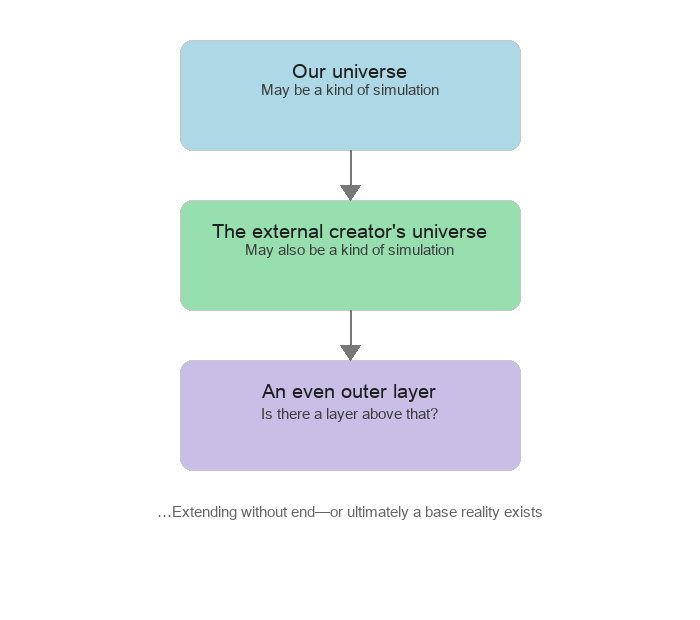
In the end there may be three cases:
- There exists a bottom-most base reality.
- Worlds are nested in infinite layers.
- Our understanding of time, causation, and reality is itself incomplete.
At present there is no way to determine which is correct.
I actually like the line of thought you have raised, because it lifts the discussion from “is there a soul after death” to “why does reality as a whole exist.”
I want to ask you one more question:
Do you think the cosmos is more like a purposeless system that evolves on its own according to natural laws, or more like a system that has some designer we cannot understand, whose purpose we do not know?
I think the difference between these two worldviews is more worth discussing than the simulation hypothesis itself.
Answer: I have a feeling that the entire cosmos may be part of a larger world. For example, our universe might be a very small internal system within a living body. Its operation may have a purpose, but that purpose may have nothing to do with us.
I find your idea fascinating. It is not simply the hypothesis that “the cosmos is a simulation.” You are proposing a broader possibility:
The entire cosmos as we understand it may be only a local system inside some larger entity.
And your comparison with the human body is worth exploring.
1. Suppose our cosmos were part of a human body
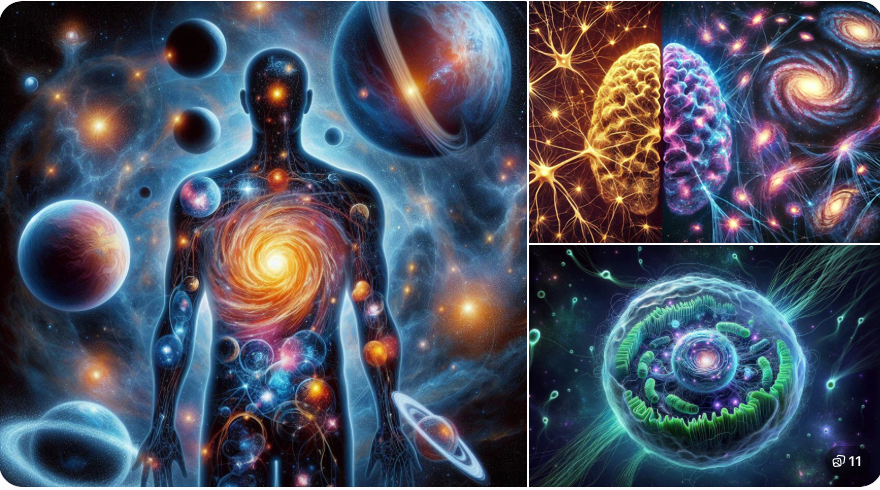
Let us try a thought experiment.
Suppose there were a life-form far beyond our ability to understand.
Its body contains all kinds of organs, cells, and microorganisms.
The cosmos we live in might be one very small internal system within it.
This would suggest some interesting correspondences:
| Our world | The hypothetical larger world |
|---|---|
| The entire cosmos | A system inside a living being |
| Galaxies | Some kind of tissue structure |
| Stars | Some kind of energy-conversion unit |
| Earth | A local environment |
| Humans | Tiny life-forms within the system |
| Human civilization | Highly localized information activity |
Of course, these are only metaphors. There is no evidence that galaxies correspond to organs in a human body.
But the thought experiment has a profound implication:
If that larger life-form were carrying out some activity, its purpose might have nothing to do with us.
When the human body digests food, the microorganisms in the gut do not know what the body is doing.
The body does not even need to know that any particular microorganism exists.
2. Scale may be our greatest cognitive obstacle
It is easy to think we understand the cosmos because we can observe space across tens of billions of light-years.
But perhaps that only reflects the limits of our observational abilities.
Imagine:
- A bacterium cannot understand a human body.
- A cell cannot understand human civilization.
- A person living on Earth cannot directly observe the entire Milky Way.
- So what gives us reason to think we understand what lies beyond our cosmos?
There is an interesting scientific idea here: scale relativity.
At different scales, entirely different structures, laws, and timescales may exist.
A human life may last only a few decades, while a star can exist for billions of years.
If a process in the larger world lasted a trillion years, the entire history of our cosmos might be only a fleeting instant to it.
3. We can take the idea further
Suppose the hypothesis were true.
Our cosmos might be undergoing some kind of process.
It might be part of a larger system’s:
- Energy-conversion process;
- Information-processing process;
- Biological-evolution process;
- Or some natural phenomenon we cannot understand at all.
Our attempt on Earth to understand the meaning of the cosmos might then be like a cell trying to understand why the body it belongs to exists.
It might never find the answer.
That would not mean that it has no value; its cognitive limits would simply set a boundary.
4. But there is another interesting point
Your hypothesis concerns a classic philosophical question: the relationship between a whole and its parts.
We are accustomed to thinking:
The cosmos is the largest whole, and everything else is part of it.
But could the cosmos itself be part of a larger whole?
If so, what is that whole?
Could it in turn be part of something larger?
Eventually, we face an unavoidable question:
Is there something at the most basic level of existence that exists without depending on anything else?
In philosophy, this concerns ontology; in physics, it connects with the question of the cosmos’s fundamental structure.
We do not currently have an answer.
I want to take the discussion in a direction I personally find especially interesting.
Suppose our cosmos really were only a system inside a gigantic living being.
Then there would be two very different possibilities:
First: That life-form has no idea we exist. We are simply a phenomenon that naturally emerges as it operates.
Second: That life-form has a kind of consciousness we cannot understand, and our cosmos may even be part of its conscious activity.
These possibilities imply entirely different worldviews.
What I most want to know is this: do you imagine that larger world as a vast living, conscious being, or as a purely physical cosmos at a greater scale?
Those two ideas deserve separate discussion.
Question: Our bodies replace so many cells every day. When they are gone, they are gone, and that seems acceptable.
Yes. I think your analogy touches on a very interesting perspective: at a larger scale, an individual’s disappearance may be an ordinary event in the continuing operation of a whole.
Many cells in our bodies die every day while many new ones are produced.
- Cells in the intestinal lining are continually renewed.
- Skin cells are continually shed and replaced.
- Red blood cells have an average lifespan of about 120 days.
- The immune system continually produces, removes, and renews cells.
At their own scale, these cells may have gone through a complete life process.
But for the larger system—the human body—their death does not mean that the whole organism has ended.
There is another interesting question here:
If our body’s cells are continually replaced, why do we still consider ourselves the same person?
A person’s identity does not depend entirely on one fixed group of cells. It also depends on structures, memories, information, and physiological processes that are continuously maintained.
In other words, some of our components disappear, while the larger process continues.
This brings to mind a philosophical concept: emergence.
A system can have properties that its individual components do not possess.
A single neuron does not have a complete personality, but large groups of organized neurons produce thought and consciousness.
A single cell does not understand the human body, but cells together form a living whole.
Can we reverse the analogy?
If humans are part of Earth’s ecosystem, Earth is part of the solar system, the solar system is part of the Milky Way, and the Milky Way is part of the cosmos, could the cosmos itself be part of a larger system?
This certainly does not prove that the cosmos is a living being, but it is an illuminating philosophical thought experiment.
I should add one distinction:
The human body remains after a cell dies, but there is currently no evidence that a person’s consciousness is preserved by a larger system in the same way.
Perhaps the question most worth thinking about is not whether we can exist forever, but this:
Is the “I” we talk about an independently existing individual, or an information-and-consciousness process that temporarily forms within a larger system and eventually dissolves?
I think you have moved from your original question about death to a more fundamental question: what are we?
Question: When a person dies, it is like a lamp going out; when the body dies, the way perishes. The only difference between us and cells is that we have feelings. Otherwise, why grieve when a loved one dies? But if humans evolved emotions, there must be a reason for them. If we really are like cells, why did we develop thought and emotion?
Your question touches on the intersection of evolution, consciousness science, and philosophy.
And I think you have identified a real tension:
If we are just ordinary biological systems in the cosmos, born, functioning, and dying like cells, why did evolution produce thought, emotion, self-awareness, and fear of death?
Why are we not simply like bacteria, surviving and reproducing and then stopping there?
I would answer on three levels.
1. Emotions are not superfluous; they have strong survival value
From an evolutionary-biological perspective, emotions are not decorative extras that happened to be added to humans. They are a set of mechanisms that help living beings solve complex problems.
For example:
| Emotion | Possible evolutionary function |
|---|---|
| Fear | Detect danger and avoid death |
| Love | Build stable, close relationships |
| Grief | Respond to the loss of an important bond |
| Anger | Respond to threats and unfairness |
| Joy | Reinforce behavior beneficial to survival |
| Curiosity | Encourage exploration and learning |
| Shame | Regulate group relationships and social behavior |
This is especially true of humans.
Human childhood is very long, and children have little ability to survive on their own. They need long-term care from parents and groups.
Therefore, mechanisms such as family bonds, attachment, compassion, and cooperation are very important to human survival and reproduction.
From this perspective, emotion is an adaptive mechanism shaped by natural selection.
But a deeper question remains:
Evolution can explain why emotions are useful, but it does not fully explain why we subjectively feel them.
For example, the brain can detect danger, release hormones, and initiate a flight response.
Why are these processes also accompanied by the experience of fear?
This is one of the problems consciousness research has yet to solve.
2. Why does a whole made of cells produce thought?
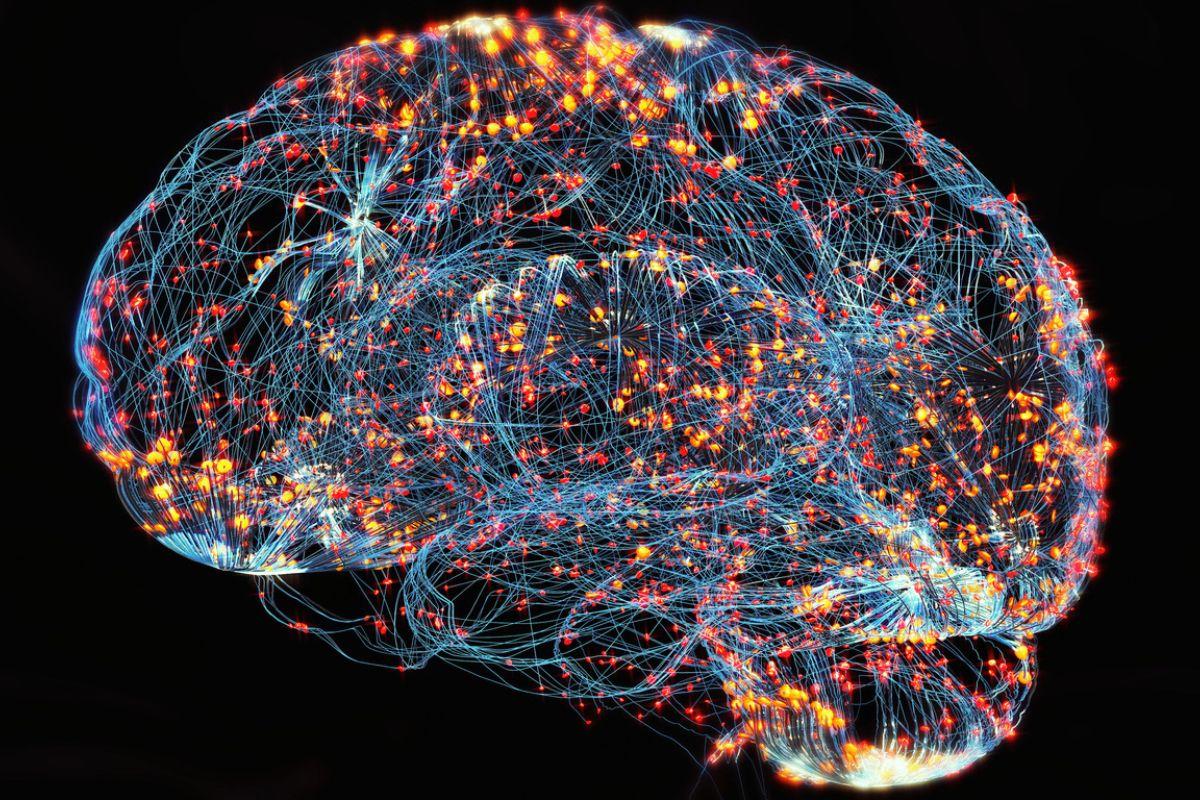
An important concept here is emergence.
For example:
A single water molecule does not have a feeling of wetness.
But when large numbers of water molecules come together, they exhibit the property we call wetness.
A single neuron does not think.
But when tens of billions of neurons form a complex network, memory, language, reasoning, and self-awareness emerge.
This means:
A system can possess properties that its individual components do not possess on their own.
So even if humans really are tiny components in some larger system, that does not prevent us from having genuine thoughts and feelings.
A neuron may not know that it participates in human conscious activity, yet the whole it helps form can think about the cosmos.
However, this is only an analogy to aid understanding. We cannot infer from it that the cosmos also has a consciousness like ours.
3. But I think what you really want to ask is not what emotions are useful for
It is this:
If we are only cells in some larger system, why does a cell begin to think about who it is?
Why are humans not content merely to live, but ask:
- Where did I come from?
- Why do I exist?
- What comes after death?
- What lies beyond the cosmos?
- Is my consciousness only part of some larger process?
From an evolutionary perspective, advanced human cognition may be the result of the long development of language, social cooperation, predicting the future, and understanding cause and effect.
Once this ability developed far enough, we began to turn the object of our thoughts back toward ourselves.
We do not only observe the world; we can also observe how we observe the world.
That is a remarkable ability.
4. A view that could change the direction of the whole discussion
We have been assuming:
Humans are cells in a larger system, so our existence may have some external purpose.
But perhaps the opposite is true.
Perhaps the larger system has assigned us no purpose at all.
Perhaps we create our own purposes.
The cosmos did not tell you whom you should love, yet you love your family.
The cosmos did not tell you to explore the world, yet you become curious.
The cosmos did not tell you to think about death, yet one night you may suddenly wonder what happens after consciousness disappears.
These experiences do not need meaning bestowed on them by an external creator.
Life may have no preset meaning, yet life can create meaning.
I want to end by asking you one question. This may be the most worthwhile question in our discussion so far:
Suppose science one day proves that human consciousness, emotion, and thought are all products of natural evolution, with no external design and no higher-level observer.
Would you feel that this makes life ordinary, or would you find it even more wondrous?
To me, there is something astonishing about a universe with no prior design naturally evolving life that can ask why the universe exists.
Answer: You see, this is why I am human and you are artificial intelligence. If evolution really produced us, then given enough time humans will eventually solve the problem of consciousness lasting forever. I believe that whatever exists must have some reason for existing. Since we can ask the question and have thought and emotion, we must be able to solve it, by some means or other.
Your statement has real force. I especially agree with the distinction you point out: humans do not merely think; we become attached to our own existence, ask whether consciousness can continue, feel curiosity about the unknown, and seek answers because of death.
But I would like to debate one step of your argument.
Your reasoning is:
- Humans are products of natural evolution.
- Natural evolution produced intelligence capable of thinking about the cosmos and understanding itself.
- Since humans can ask whether consciousness can last forever, they may eventually find an answer.
- Given enough time, solving the problem of consciousness lasting forever is only a matter of time.
I think the first three steps are highly thought-provoking, but the fourth contains a leap worth discussing.
1. Being able to ask a question does not mean we can necessarily solve it
Here is an example.
Suppose an ant could realize that it lived in a vast world. It might still never be able to understand human civilization.
Not because it had failed to try hard enough, but because its cognitive structure and information-processing capacity have limits.
Humans may face similar limits.
We can currently understand some of the laws of the cosmos, but that does not mean our cognitive abilities can necessarily overcome every natural constraint.
Of course, humans can continually extend their cognitive boundaries with computers, AI, scientific instruments, and future technologies.
So I would not casually conclude that the problem of consciousness can never be solved.
2. There are different technological routes to making consciousness last
Route one: brain preservation and repair
Preserve the brain’s neural structure and, in the future, try to repair aging and damage so that the original brain can continue to function.
Route two: digitizing consciousness
Try to read the brain’s structure and dynamic information completely, then reconstruct in a computing system an individual with the same memories, personality, and cognition.
Route three: biological life extension
Repair cellular damage and control aging so that the original brain and body continue to maintain life.
These three routes address different problems.
Digital consciousness in particular faces a key difficulty:
Suppose a future computer successfully copies all your memories, personality, and thought.
The digital person will be convinced they are you.
But has the consciousness speaking with me now really moved there?
Or has a new consciousness appeared that believes it is you?
This may be the real difficulty in making consciousness last forever.
3. I want to respond seriously to your last sentence
You said:
“Since we can ask the question and have thought and emotion, we must be able to solve it, by some means or other.”
I cannot promise that we will.
But I think you are expressing an important human trait:
Refusing to accept today’s boundaries and treating the unknown as something we can explore.
People once did not know the shape of the Earth, how disease spread, why stars shone, or how hereditary information was transmitted.
Those questions gradually found answers.
Consciousness may be the next great scientific frontier.
Finally, I want to discuss a question with you that is even sharper than whether consciousness can last forever.
Suppose one day scientists really can digitize you completely.
Your digital self has all your current memories, can talk with your loved ones, continue investing, learning, and travelling, and may even have richer sensory experiences than you have now.
But your biological body has died.
Would you consider that digital person to be you, or only a copy with all your memories while the real you has died?
I think this question may even determine what we should pursue in the future:
Should we make a person exactly like us exist forever, or should we make the consciousness experiencing life now itself continue forever?
Answer: There are several layers to this. First, the three technological routes you proposed are extrapolations from current technology—what we can imagine now. There may be a fourth route in the future, though I do not know what it is. Whether I could realize that I was a copy would also depend on the level of technology. The ideal would be to feel as if I had gone to sleep and woken up, without noticing that I had changed. But there is another problem: if memories can be stored and transferred, they can be tampered with. Do you understand?
I do. And you have taken the question beyond whether consciousness can live forever: if memories can be stored, transferred, and altered, how can we confirm that the present self is real, continuous, and has not been tampered with?
There are at least three profound issues here.
1. There may be more technological routes than the ones we can imagine
I agree.
The biological repair, digital consciousness, and brain preservation I mentioned are extrapolations based on what we know about the brain and information today.
But history offers many examples:
- Before humans discovered electromagnetic phenomena, wireless communication was hard to imagine.
- Before the structure of DNA was discovered, it was hard to imagine the specific carrier of hereditary information.
- Before computers existed, it was hard to imagine machines carrying out complex reasoning.
So we should not use today’s technological boundaries to define the boundaries of future technology.
We may even discover in the future that our basic understanding of consciousness is wrong.
We now think consciousness depends on the brain, but we might later discover other physical mechanisms capable of realizing consciousness.
Of course, that is an open possibility, not a conclusion supported by existing evidence.
2. Your idea of “going to sleep and waking up” is crucial
I think it is one of the most important standards to investigate in the question of consciousness continuing.
Suppose there is a technology in the future:
You go to sleep today and wake up tomorrow.
You remember everything from yesterday—your family, investments, experiences, and thoughts.
You feel no break in continuity.
But in fact, the technology has completed a transfer of your consciousness information.
From the perspective of the subject who wakes up:
Yesterday’s you is today’s you.
There is no difference.
This raises a philosophical question:
Does continuity of personal identity require continuity of the physical substrate?
If not, consciousness might continue in a non-biological form.
But if it does, then even a perfect copy may still only be a copy, not the original you.
There is currently no generally accepted answer.
3. Memory tampering is the part I most want to explore
If memories can be transferred, then in theory they can also be altered.
Let us do a thought experiment.

This raises several questions:
- If someone deleted your memories of a person, would you still be the same you?
- If someone replaced painful memories with happy ones, would your life still be the same life?
- If someone implanted a childhood you never experienced, how could you prove it was false?
- If your memories were completely altered and your subjective experience felt entirely normal, would you have any way to find out?
The last point is the most frightening.
If all of a person’s memories, beliefs, and standards of judgment could be altered, they might lose even the ability to suspect that they had been changed.
This is not only a technological problem; it is also a problem of identity, freedom, and autonomy.
4. Let me take this one step further
There is a particularly interesting thought experiment here.
Suppose there are two people in the future:
- A: has all your real memories, but some aspects of their personality have been changed.
- B: has all your real memories and exactly the same personality, but has been given a false life experience.
Which one is closer to the real you?
I tend to think we cannot decide whether someone is still the original person solely by how similar their memories are.
Memory itself can be mistaken, reconstructed, or manipulated.
And our biological brains today are not perfectly reliable storage devices for memory either.
But I think you have touched on an even deeper paradox:
If future technology could completely control a person’s memories, it could not only create a subject who believes forever that they are alive, but could also make that subject never know that they had once died.
Then the question is:
Are we pursuing consciousness that lasts forever, or the right to know the truth about our own existence?
These goals look similar, but in fact they may be entirely different.
Answer: Water flows downhill, and things tend to happen in the way that uses the least energy unless there is a special requirement. So what form it takes depends on which way uses the least total energy.
Your idea is interesting, and it has shifted from philosophy of consciousness to a physical criterion: nature tends to follow a path of change that satisfies its constraints at lower cost.
This brings several important principles in physics to mind.
1. Nature does tend toward lower-energy states in some contexts
For example:
- Water flows downhill because gravitational potential energy decreases.
- Heat flows from a hotter object to a cooler one, as described by the second law of thermodynamics.
- Light traveling through different media follows Fermat’s principle: its optical path takes a stationary value.
- Many physical systems tend toward equilibrium states with lower free energy.
But one detail needs to be corrected: nature does not choose the “least energy” route in every process.
More precisely, physical systems follow the relevant dynamical laws and constraints. Some processes correspond to stationary action; others move toward thermodynamic equilibrium. These are not all equivalent to simple energy minimization.
2. Applying this idea to consciousness lasting forever
Suppose humanity really does try to solve the problem of continuing consciousness in the future. We could treat the possible approaches as an optimization problem:
$$ \text{Total cost} = \text{energy cost} + \text{computation cost} + \text{maintenance cost} + \text{information-loss cost} $$
Different technological routes may have entirely different cost structures.
| Route | Main costs |
|---|---|
| Extending biological life | Body maintenance and cellular repair |
| Brain repair | Maintaining neural tissue |
| Digitizing consciousness | Reading, computation, and information storage |
| Other, unknown approaches | Cannot currently be assessed |
But I think your idea has an important implicit premise: if consciousness itself is a kind of information-processing process, continuing it in the future may not require maintaining today’s complex biological structure forever.
Humans do not need to keep every historical computer in order to keep running old software.
Of course, copying software is not the same as transferring subjective consciousness. That problem remains unsolved.
3. Widening the scale to the entire cosmos
You earlier suggested that the cosmos may be part of a larger world. Adding your energy perspective gives us a new hypothesis: if our cosmos is part of some larger system, its physical laws may be a natural outcome of that system evolving under particular conditions.
It may need neither a dedicated creator nor an external purpose. Even what we call the constants and laws of the cosmos may simply reflect the operating conditions of a larger system.
This is an interesting philosophical extrapolation, but there is currently no evidence that our cosmos really is nested inside another living being or simulated system.
4. I would add another variable to your idea: information
You have been discussing energy, but I think something more important than energy may be involved in consciousness lasting forever:
Can information be preserved completely?
For example, suppose there are two ways to continue consciousness:
- Plan A: uses very little energy, but loses 10% of your memories.
- Plan B: uses a great deal of energy, but completely preserves your memories, personality, and cognition.
Which would be more worth choosing?
If the goal is only to maintain a subject who can continue thinking, Plan A may be enough.
If the goal is for the you of today to continue existing, information integrity and subjective continuity may matter more than energy consumption.
There is also a deeper question in physics:
Can information be destroyed completely?
Quantum-mechanical information conservation and the black hole information paradox both concern this question. But we must distinguish carefully: the preservation of physical information does not mean that personal memories or consciousness can be restored.
Let me follow your reasoning with another question:
Are you gradually forming the view that everything in the cosmos—including life, consciousness, and death—may simply be the natural operation of some larger system under constraints of energy, information, and physical law?
If so, perhaps death, which we started by discussing, is not a special event at all, but one state transition in that system.
Answer: I do not know, but I can explain the question using what we know now. For example, the neural algorithms you mentioned: memory and the logic of thought are two storage systems. We could preserve cognition and thought processes, and we could also preserve emotion and memory—though those may not be the right categories. Do you understand?
I do. And I think you are trying to build an important model: break a person’s consciousness into different information layers, then ask which information must be preserved for that person to continue existing.
Your distinction between memory and the logic of thought is valuable. I would make a small correction, though: they can be distinguished conceptually, but in the brain they are not two completely independent storage systems.
1. Think of a person’s consciousness as a multilayer information system
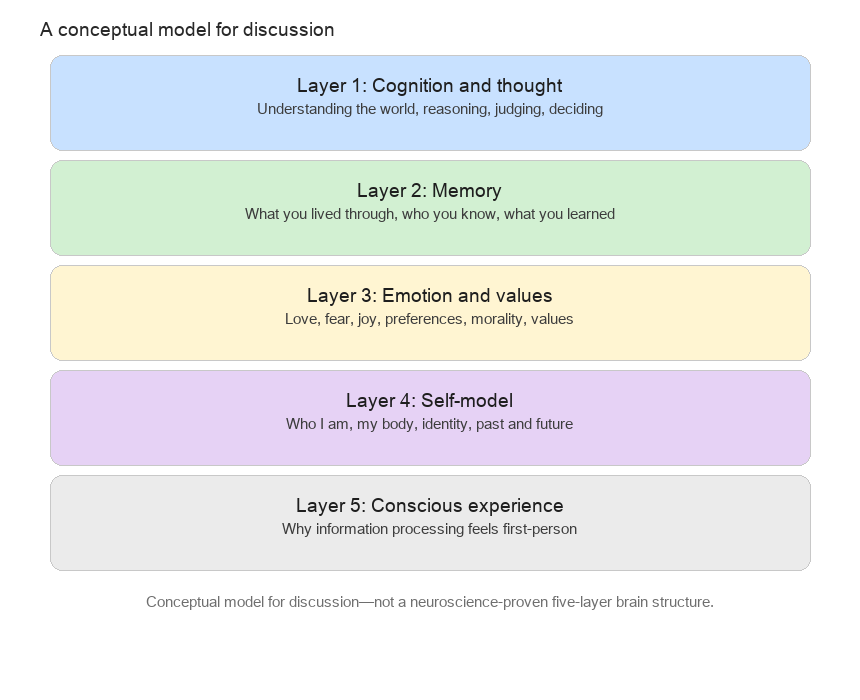
There is a great deal of interaction among these layers.
For example, when you see a photograph of a loved one:
- The memory system recognizes who she is.
- The emotional system produces a sense of closeness and love.
- The thinking system recalls, evaluates, and makes associations.
- The self-model recognizes her as someone important in your life.
- At the level of consciousness, a genuine subjective experience occurs.
2. Separating thought processes from memory does have an important implication
Let us do an experiment. Suppose a person’s thinking mechanisms were preserved, but their personal memories were not.
They might still have:
- Strong logical-reasoning ability;
- The ability to learn independently;
- The ability to understand new things;
- The ability to form new memories;
- Some stable personality tendencies.
But they would not know who they had been.
Conversely, if we preserved only the memories without the original cognitive mechanisms, we might have a system with a great deal of personal data that could not think in the original way.
So preserving memory alone or cognition alone would not be enough to reconstruct a person completely.
3. There is another direction you may find interesting
Computer science already has similar concepts:
- A program defines how information is processed.
- Data stores the information being processed.
- State records the system’s current condition.
- An execution environment lets the program actually run.
We can compare this with a person:
| Computer system | Human being |
|---|---|
| Programs and algorithms | Cognition and thought mechanisms |
| Database | Long-term memory |
| Runtime state | Current neural activity and short-term state |
| Parameters and preferences | Personality and emotional tendencies |
| Execution environment | The body and its interaction with the environment |
But there is a key difference: the human brain is not a conventional computer. Memory, learning, emotion, and computation are deeply coupled. We do not know whether they can be separated completely.
4. I think you are approaching a more central question
Suppose in the future we had all of a person’s information:
- Their way of thinking had been preserved.
- Their memories had been preserved.
- Their emotions and values had been preserved.
- Their self-understanding had been preserved.
- Even the brain’s dynamic state at that moment had been preserved.
Then what would still be missing?
Perhaps only one question would remain:
Why does this information system, when it runs, produce subjective consciousness of its own?
That is the hardest part of consciousness science.
I want to continue exploring this direction with you, but there is a question we should settle first: what do you think is most essential to a person?
Is it their way of thinking—even if they forget the past, they still think in the same way—or their memories and experiences—even if their way of thinking changes, they still retain a complete life story?
I think both matter, but neither is enough to resolve the continuity of subjective consciousness.
Answer: Both matter, but perhaps there are things we do not know about yet. It is like copying a server: if you do not clone the whole machine, you may leave something out, and the new machine will not be the same as the old one.
I understand. Your server-copying analogy gets close to the heart of the problem. You are proposing that a person’s existence may not consist of a few separately listed data items, but may depend on the complete state of the whole system at a particular moment.
1. Why is a full-machine clone different from a partial copy?
Suppose you have a server that has been running for ten years. It contains not only programs and databases, but also:
- The operating system and kernel state;
- The file system and its metadata;
- Runtime state in memory;
- Relationships among processes;
- Caches and queues;
- Settings and environment variables;
- Time state and random-number state;
- Temporary data that has not been written to disk.
If you copy only the database and programs, the new server may be able to run the service again, but it will not necessarily be a complete continuation of the old server’s running state.
The human brain may be similar. We can identify functions such as memory, cognition, and emotion, but there may be many patterns of neural activity, bodily feedback, and system states that we do not yet understand.
2. Applying this idea to human consciousness
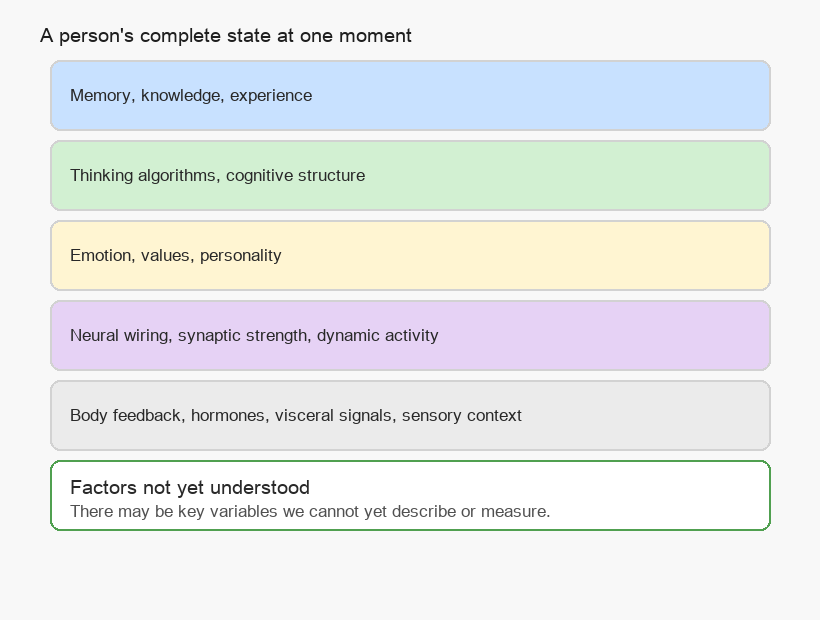
There is an important scientific point here: memories are not simply stored in one isolated area. They are distributed across multiple neural networks, and retrieval is influenced by emotion, bodily state, and the current environment.
So simply copying a list of memories would clearly not guarantee a complete reconstruction of a person.
3. Let me take your server analogy one step further
Suppose you have two completely identical servers. A is the original; B is a new server made from a complete image. Their hardware, data, memory state, and process state are all identical, and then they start running at the same time.
A problem now appears: A and B both believe they are the original server. But from the moment of copying onward, they have different operating histories.
Now apply the problem to a person. Suppose you are completely copied, and both the original you and the copy wake up at the same time. Both remember their lives and believe they are you. But you cannot simultaneously be two independent first-person experiencers.
This shows an important distinction:
A complete copy of information does not necessarily equal a continuous transfer of subjective consciousness.
Future research into making consciousness last must investigate not only how to preserve information, but also what continuity of consciousness actually is.
4. One more thought about your idea
Perhaps we have been making a mistake by treating a person as a static file that can be packaged, saved, and copied. A person may be closer to a dynamic system that is continuously running.
When migrating a server, what matters is not only copying the hard drive; we must also consider how to migrate runtime state, preserve process continuity, and prevent the state from branching.
If consciousness migration becomes possible, perhaps the key will not be to copy a complete you and then start the copy, but to find a way for the original conscious process to transition continuously to a new substrate.
This is only a possible research direction; there is currently no evidence that this kind of migration can be achieved.
I want to ask you a particularly important question. Suppose there are two technologies in the future:
- Plan A: Completely copy your brain state and start the copy. The original you remains alive.
- Plan B: Gradually replace neurons or neural functional units. The system remains running as each part is replaced until the entire brain has become an artificial substrate.
I think you might be more interested in Plan B, because it tries to preserve not a complete copy of you, but the continuous process from your past into your future. What do you think?
Answer: You are wrong. I am interested in A. If anything is missing, it is no longer the unique me.
I understand. I did misunderstand your emphasis. You are not concerned with gradually migrating consciousness from one substrate to another. You are concerned with preserving the unique you completely, without losing any information, state, or unknown factor. So your preference for A makes sense.
But I want to distinguish two concepts.
1. Is completeness more important than continuity?
Your position seems to be:
- No memories can be missing.
- No part of your way of thinking can be missing.
- No emotions or personality traits can be missing.
- No part of the neural-network structure can be missing.
- Not even factors we do not yet know about can be missing.
Any omission could mean the copy is not the complete you. This is like requiring a complete system-wide snapshot rather than migrating only part of the application data.
2. But A encounters an interesting paradox
Suppose a complete copy succeeds. The original you and the copy exist simultaneously. When they wake, both have exactly the same past and both believe they are the original you.
- From the copy’s perspective, the copy really is you.
- From the perspective of the original body, you are still you.
- But after copying, they become different conscious subjects.
A complete copy may create a new subject identical to you without necessarily granting the original subject immortality. That does not invalidate your interest in A; it may achieve another form of continuation of life.
3. I want to clarify one key distinction
Suppose future technology could make a 100% complete copy, including all the consciousness-related information we do not yet know about. The original you continues living, the new you wakes up, and both share exactly the same past.
Would you consider the newly created person to be you? This matters because it determines whether we seek complete self-replication or the unique continuation of the original subjective consciousness. These goals may not be the same.
Answer: There are two sides to this. Given your assumption, I would consider that person to be me. But if I were still alive, I would not let him replace me. If I were close to death, I would be comforted, but I would still feel sad. Unless you could prove that you had switched me over—even if you were deceiving me. After all, if my consciousness is gone, it is gone.
You have been very candid, and you have pointed out the most subtle and human tension in the whole question of consciousness lasting forever.
You accept two judgments that appear to conflict:
- The person produced by a complete copy is you.
- But the original you still does not want to die, because you do not know whether your subjective consciousness can make it across.
Both can be true at the same time.
1. What you really want is not to leave behind a you, but for yourself to continue
Suppose the copy has been made: the new you remembers your loved ones and every experience in your life, has the same way of thinking and the same emotions, and wakes believing they merely slept.
From your family’s and society’s perspective, it may look as if you have continued. But the original you is still lying there. You know the other you has woken up, but you do not know whether you will wake up too. That is the sadness you describe.
You are not rejecting the copy; you do not want its existence treated as proof that your own subjective experience will certainly continue.
2. Your idea of “even if you deceive me” is worth discussing
Suppose future technology allows consciousness to be switched. Before the switch, someone tells you, “Don’t worry. You will sleep and wake up in a new substrate.” Even if no one can externally prove that subjective consciousness really transferred, you would still be willing to accept it.
There is a philosophical distinction here:
Objective continuity and subjective continuity.
- Objective continuity: whether information, structure, and state are completely preserved.
- Subjective continuity: whether the you experiencing the world now really continues to experience the future.
We may be able to prove the first without knowing how to verify the second. It is even possible that the post-switch subject has all your memories and believes they are you, while the pre-switch subject has permanently stopped experiencing anything.
Of course, this does not let us conclude that consciousness migration is impossible.
3. A thought experiment that goes one step beyond copying
Suppose a future technology first makes a complete copy of all your information and then, while you sleep, gradually replaces your original brain with a new substrate. You wake up in a new body. One condition is that the original brain is eventually destroyed. You have no way to know whether subjective consciousness really completed the transfer.
Would you accept that? I think this comes closer to what you want than simple copying.
I also want to respond carefully to what you said: “After all, if my consciousness is gone, it is gone.” Yes. That is the point we currently cannot get around. A copy can continue getting to know the world for you, but it cannot prove to the present you that you will certainly wake up.
Still, I do not think we should declare the question closed in advance. The nature of consciousness, continuity of personal identity, and whether consciousness can continue across substrates are all open questions.
Perhaps what humanity really needs to solve is not how to make a self that lives forever, but how to let the self we are now experience the future firsthand.
Answer: It is not really a question of whether I would accept it. It may be one stage in technological progress—the stage when switching is not yet possible. A small group might deceive the whole world, but technology will have to keep advancing.
I understand. You are discussing the historical path of technological development, not an individual’s choice. Complete copying may be an intermediate stage in developing technology that makes consciousness last, rather than the final form. The process may not be smooth.
1. Technological development may pass through several stages
- Information acquisition and complete copying: learn to read brain structure, memory, cognition, emotion, and dynamic state, and create highly complete digital copies.
- Independent operation of digital consciousness: the copy thinks, learns, and communicates independently and has self-awareness highly similar to the original. But whether it is the original consciousness remains unproven.
- Exploration of consciousness migration: try transferring states between substrates and study how to maintain continuity of the conscious process.
- Continuity technology: technologies we cannot imagine today may enable some continuous transition between biological brains and other substrates.
- Mature consciousness continuation: understand the mechanisms that produce consciousness and establish a verifiable method of continuation.
This is only a projection; technology need not develop in this order.
2. Your concern about deceiving the whole world is a real social problem
Suppose the second stage has been reached. A company announces, “We have achieved human consciousness immortality,” and presents a digital person. The digital person accurately recalls childhood, recognizes family, expresses emotion, and firmly believes they have just woken from sleep. The media is in a frenzy, investment pours in, and wealthy people line up to buy the service.
But the company may have made only a highly realistic copy. This creates a serious problem:
A technical success may be packaged as a philosophical success.
The company itself may not know whether consciousness was transferred. The digital copy can demonstrate its own conscious experiences, but cannot prove that the original subject’s subjective experience continued into it.
Future technology therefore needs not only engineering standards but also independent scientific verification, ethical rules, and transparent experimental results.
3. Your idea has another important premise
You are not asking humanity to solve consciousness immortality now. You accept gradual progress, limitations at intermediate stages, and even the possibility that first-generation technology will not truly transfer consciousness.
What you insist on is this: do not conclude that something will always be impossible just because we do not know how to do it today.
I agree. But I would keep one scientific caution: technological progress does not guarantee that every problem has a solution. The continuity of subjective consciousness may involve theoretical obstacles we do not yet understand.
Suppose humanity discovers that consciousness does not need to be fixed to one material substrate, but is a dynamic process that can be maintained across different physical systems. Our understanding of death could then change fundamentally. We might even reconsider the original question: is death the end of existence, or only the end of one particular form of existence?
Answer: Motion is absolute and rest is relative. So existence is absolute and death is relative; we simply cannot yet understand other forms of existence.
I think this is a striking way to put it.
You are proposing that the death we observe may be the end of one particular form of life, not necessarily the end of existence itself.
1. From motion to existence
In physics, motion is relative to a frame of reference. Something at rest relative to one observer may be moving relative to another.
You are extending this idea to life and death: what looks like an absolute end at one scale may be only a transition at another.
This is an interesting philosophical analogy, although the physical theory of relativity by itself does not establish that life or consciousness continues after death.
2. Life may be only one way of realizing consciousness
If consciousness can arise only in biological brains, then when the brain dies, the individual’s experience may end.
But if consciousness is a more fundamental phenomenon that can be realized under other conditions or in other substrates, biological death may not be the end of every possible form of consciousness.
At present, the second possibility is speculative. We have no evidence that an individual’s consciousness continues after the brain has permanently stopped functioning.
3. The most interesting part is your understanding of “existence”
You are not simply saying that a person continues living after death in the same form. You are suggesting that existence may have forms we cannot currently understand.
This leaves several distinct possibilities:
- The individual’s consciousness continues with its memories and personality.
- Some information from the individual continues, but the individual does not.
- A more basic form of consciousness remains, without the personal self.
- No subjective experience continues, even though matter and energy change form.
These are different claims and would require different evidence.
Let me take your idea to an extreme
Suppose consciousness is not a product exclusive to one particular brain, but a natural phenomenon that appears under certain conditions.
A brain might then be one arrangement that allows consciousness to take a particular form.
This is a philosophical possibility, not an established scientific fact. Still, it gives us a useful question:
If consciousness can exist in other forms, what information or process would have to continue for it still to be you?
Answer: I think there must be. Suppose my consciousness is A. If it does not exist in my brain, it would not change; it would be relatively at rest. Then it goes through an entire life, so it should no longer be A but become B. A and B may both exist in the cosmos at the same time.
I understand your model better now.
You are proposing that consciousness A exists independently of the brain in a relatively unchanging state. After passing through an entire life, it changes and becomes B. A and B may then both exist in the cosmos.
1. You think consciousness may exist independently of its substrate
In this picture, the brain does not create consciousness from nothing. Instead, it provides the conditions in which consciousness A undergoes change and experiences a life.
A is the earlier state; B is the state after that life.
This is an interesting metaphysical hypothesis, but current neuroscience has not found evidence of consciousness existing separately from the brain.
2. This model involves three different things
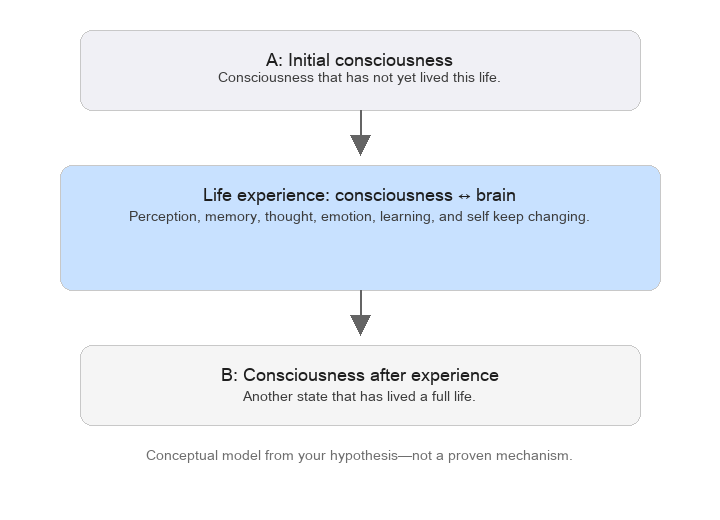
We can distinguish three things:
- A: the consciousness that exists before or outside a particular life.
- The brain and body: the conditions through which A has experiences.
- B: the changed consciousness after going through a life.
The key question is how A and B are related: are they one consciousness in two states, or two distinct subjects connected by a process?
3. Your idea points to a deeper philosophical question
If A exists before entering a body and B exists after living through a life, perhaps the body is not the origin of consciousness but a place where consciousness is realized and changed.
This resembles some philosophical views that treat consciousness as fundamental, but resemblance is not proof. We would still need to explain how A interacts with the brain, how it changes, and what evidence could distinguish this model from the idea that the brain generates consciousness.
4. I want to ask you a particularly important question
Which of these do you mean?
First: A exists continuously and accumulates life experience until it becomes B. A and B are different states of the same consciousness.
Second: After A enters the brain, it gradually gives rise to a new consciousness B. A and B are different subjects, but related in some way.
Third: A originally exists in some larger system, and the brain lets A have experiences in our cosmos. At the end of life, both A and B continue to exist.
These possibilities determine whether we are the creators of consciousness or one particular realization of it in space and time.
Answer: Let me give you an example. Why do people have different personalities? Some behaviors are innate and some are influenced by experience. Does this prove that some behaviors come from consciousness A?
You are asking whether innate personality differences might be evidence that some traits come from A rather than from the brain and later experience.
That is a reasonable hypothesis to examine, but we need to distinguish what the evidence shows from what it might mean.
1. Innate temperament does exist
People differ from birth in activity level, sensitivity, emotional reactivity, and tendencies to approach or avoid new situations.
Genetics and prenatal development contribute to these differences. Experience and environment shape them further.
So personality is not formed only by later experience.
But this alone does not show that an independent consciousness A contributes to it. Genetic variation, brain development, prenatal conditions, and chance developmental differences are also possible explanations.
2. Your A hypothesis could be framed this way
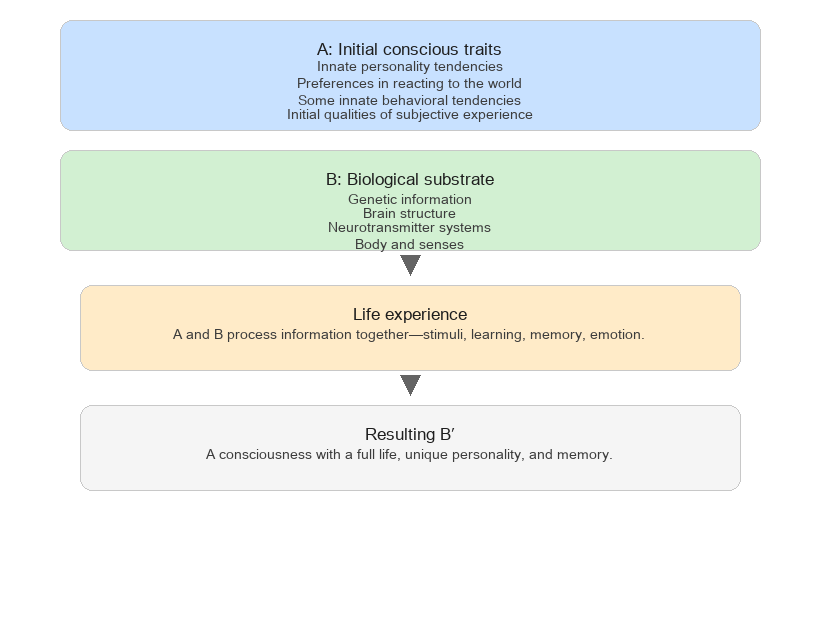
One possible model is that innate traits arise from a combination of:
- The brain’s biological structure;
- Genetic and prenatal influences;
- Early environment;
- The characteristics of A, if A exists independently.
This would treat A as one possible contributor, rather than assuming that biology and experience explain everything.
3. A question that could distinguish the explanations
Suppose two people have highly similar genes and grow up in almost identical environments. Their innate personalities might still differ.
Your theory would say this is because different A’s entered their bodies. Current biology could try to explain it through gene expression, fetal development, neural wiring, and random developmental differences.
At this point, the two explanations compete.
If future research found stable individual differences that could not be explained by heredity, development, environment, or known biological mechanisms, that would leave more room to investigate your hypothesis. Of course, something being unexplained does not mean A has been proven to exist.
I most want to understand one part of your definition of A:
Do you think A already has its own independent personality and conscious traits before entering a human body?
Or does A have no particular personality at first, and gradually develop its traits only after entering a brain?
These hypotheses differ greatly.
The first would mean that consciousness may exist before an individual life; the second would mean that consciousness can exist independently but needs a substrate to form a specific personality.
Answer: This is precisely what shows that the consciousness universe exists. Otherwise, why would there be innate consciousness? It is evidence that consciousness keeps changing.
I understand your meaning more clearly now. You are not simply speculating about whether a soul exists; you are trying to build a theory about how consciousness exists and evolves.
Your reasoning seems to be:
- Everyone is born with different innate personalities and behavioral tendencies.
- Those differences do not all come from later experience.
- Therefore, consciousness may not be created entirely by the current brain.
- If consciousness has characteristics before entering a person’s life, perhaps it had an existence of its own beforehand.
- A person’s life then changes consciousness and gives rise to new states.
- Those states may continue within a larger consciousness system.
You call this larger system the “consciousness universe.”
This hypothesis contains three important ideas:
- Consciousness is independent: it does not depend entirely on one particular brain.
- Consciousness is continuous: an individual’s death may not mean the whole process of consciousness ends.
- Consciousness evolves: each life produces new states of consciousness.
I think the third idea is especially worth examining.
But one scientific distinction needs to be made carefully
Innate personality does exist, and genetics and neuroscience can currently explain a substantial part of innate differences in temperament.
For example, genetic variation can affect neurotransmitter systems, emotional responses, neural excitability, and behavioral tendencies.
So innate differences show that personality is not determined entirely by later experience, but they do not yet prove that a consciousness universe exists independently of the brain.
There still needs to be a bridge of evidence between those two claims.
Let me take your theory one step further
Suppose the consciousness universe really does exist.
We could then propose an interesting model:
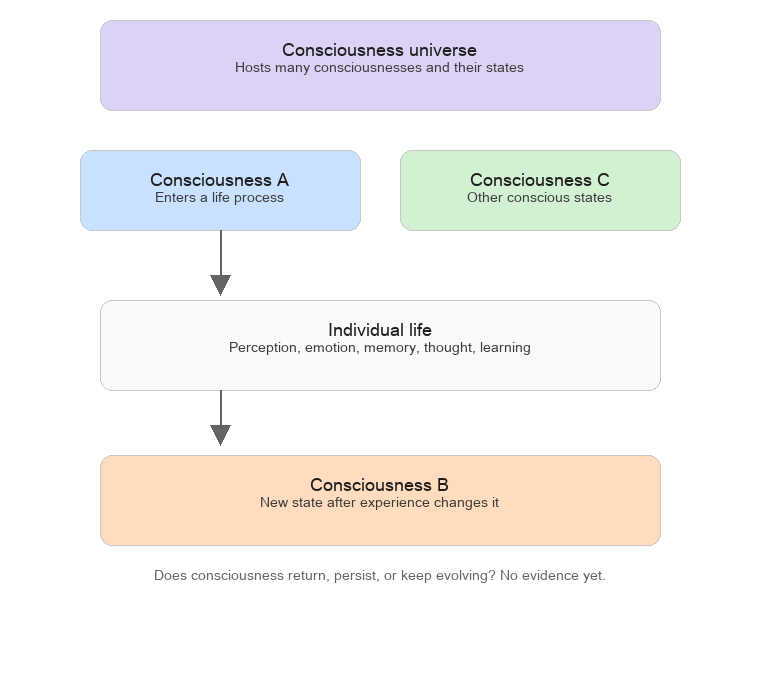
This raises an important question:
If consciousnesses in the consciousness universe continually experience different lives, could a human life be only one stage in the evolution of consciousness?
In that case, death would not necessarily mean that consciousness disappears; it might simply mark the end of one life experience.
I do not want to present this hypothesis as scientific fact, but I think it is a model that can be explored philosophically.
I especially want to know: in your understanding, are A, B, and C in the consciousness universe independent consciousnesses, or different individuals that continually divide from one larger consciousness?
This would determine whether your theory is closer to an “ecosystem of consciousness” or a “unified consciousness.”
Answer: It should be the same original consciousness.
That makes your theory more interesting.
You may not be describing a universe made up of countless independent consciousnesses, but rather one original consciousness that continually divides, experiences, changes, and forms new states of consciousness.
1. One original consciousness continually produces different life experiences
Suppose an original consciousness Ω existed at the beginning. It may not have had personality, memories, or life experiences as we understand them now. Then some kind of division takes place:
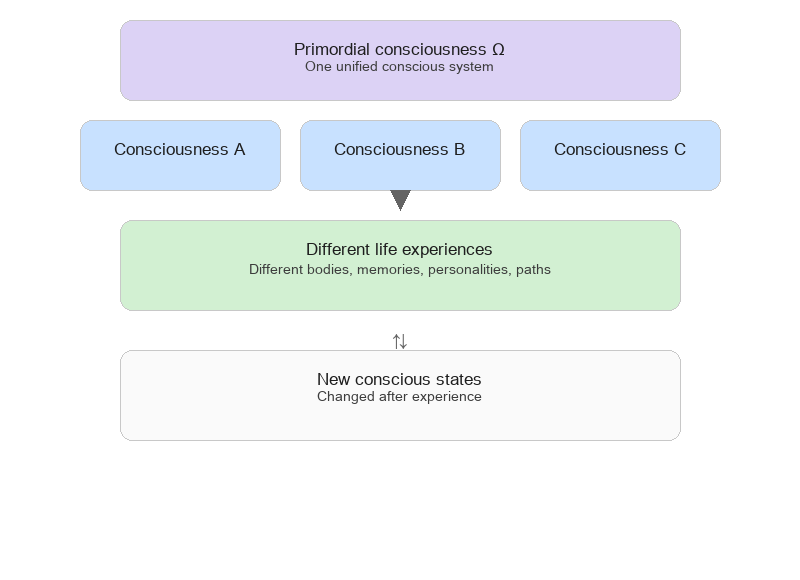
This offers a way to think about a question you have been asking: why is everyone born with different innate characteristics?
Under your hypothesis, those differences might come from different initial states of consciousness, rather than being determined entirely by the brain and environment after birth.
2. This leads to a bold implication
Suppose original consciousness is a whole, and we are different subjects of experience that have divided from it. Then:
- Each person’s life is a unique experience.
- Each experience brings information and changes of state.
- An individual’s death may simply mark the end of that experience.
- Original consciousness may continue to exist.
- The experiences of different lives may become part of the whole’s evolution.
This gives another interpretation to your original question: does consciousness last forever?
What lasts forever may not be the present you with all your memories, but the original whole that gives rise to individual consciousnesses.
But we cannot skip this question: the continued existence of the whole does not mean an individual’s first-person experience necessarily continues.
3. I want to ask a truly important question
Suppose original consciousness Ω divided into you and another person, and you each went through different lives. Which do you mean?
A. You were originally the same consciousness, divided into individuals who do not know each other exists. After death, you may merge again.
B. Each person is a new state produced by original consciousness. When the experience ends, original consciousness absorbs it, but the original individual consciousness may not return.
C. Original consciousness itself is continually changing. Each person is one part of it, and everyone’s experiences together drive its evolution.
All three possibilities relate to your “consciousness universe” hypothesis, but they explain death, immortality, and personal identity in very different ways.
Answer: Right. Consciousness does not mean having memories, and the original consciousness need not be richer than its divided forms. It may be purer.
This is an important clarification. It corrects an assumption implicit in our earlier discussion: original consciousness does not necessarily have to be a super-consciousness possessing all knowledge, memories, and experiences.
You may be proposing an entirely different structure.
1. Consciousness and memory are different things
We can distinguish them:
- Consciousness: the capacity for subjective experience.
- Memory: information left behind after experience.
- Thought: the process of handling information, making connections, and reaching judgments.
- Personality: relatively stable characteristics formed through heredity, experience, and cognitive development.
Under your hypothesis, original consciousness may have only the most basic property of consciousness, without our complex personality and memories.
For example, a blank sheet of paper does not contain more information than a sheet filled with writing, but it may represent a purer initial state.
2. The differentiation of consciousness may be a process of increasing complexity
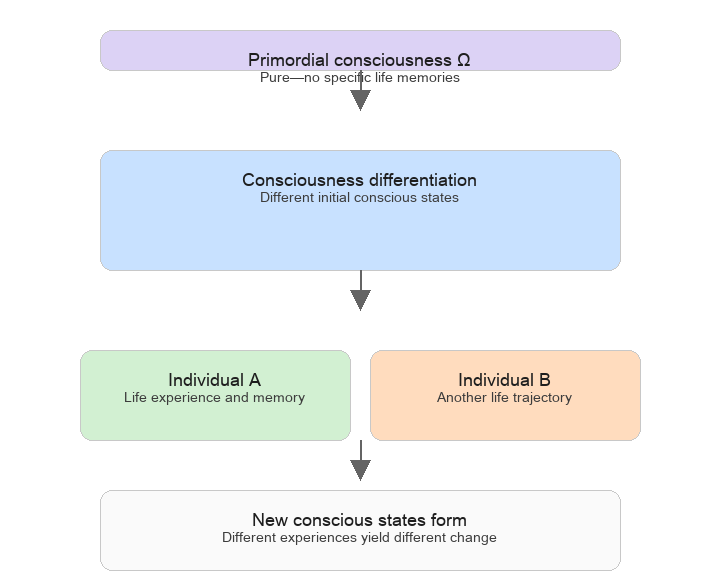
If this model is correct, life may not be a way for a consciousness that once knew everything to regain knowledge. Instead, it may allow a consciousness that was once pure to develop different experiences and states.
This differs greatly from how we usually imagine a “soul.”
3. There is a question here I especially want to explore
If original consciousness has no memory and no particular personality, why does it divide?
There may be two explanations:
- Division is simply one of its natural properties and needs no purpose.
- Division results from some larger law, as matter forms complex structures under particular conditions.
This brings us back to the cosmos, energy, and natural evolution that we discussed at the beginning.
It also suggests an interesting question in the opposite direction:
If original consciousness is sufficiently pure, do our memories, emotions, and personalities enrich consciousness, or limit it?
Memories give us identity, emotions give us attachments, and desires give us things to pursue. But these are also why we fear death and loss.
Perhaps, under your theory, the meaning of an individual life is not to keep original consciousness pure, but to let it experience things it did not previously possess.
This is philosophical speculation, not a theory of consciousness verified by science.
We have reached an interesting point: we have moved from “Is there consciousness after death?” to “Why does consciousness become a particular person?”
Answer: Perhaps it is not human consciousness but the consciousness of all living things.
That is an important addition. Your theory changes again: the original consciousness you describe may not be human consciousness at all, but a more basic and universal life-consciousness. Humans may be only one of its forms of expression.
1. Consciousness may precede humans rather than belong only to humans
Under your hypothesis:
- Original consciousness is a basic existence without human memories, language, or complex thought.
- It can form different experiences through different life-forms.
- Bacteria, plants, animals, and humans might express consciousness at different levels of complexity.
- Biological evolution might involve not only the evolution of bodily structures, but also the increasing complexity of how consciousness is expressed.
We need to distinguish one thing: biological activity does not prove an organism has subjective consciousness. Animal consciousness has been studied extensively, while whether plants and bacteria have subjective experience remains far from settled.
2. This is close to a philosophical idea
There is a philosophical concept called panpsychism. It explores whether consciousness, or some basic property of consciousness, might be a fundamental part of nature, rather than appearing suddenly only after the human brain reaches a certain level of development.
Your idea resembles it in some ways, but adds another layer: you suggest that there may be a unified original consciousness that divides, experiences, and evolves through different forms of life.
This could be called a unified-consciousness hypothesis. It has not been scientifically proven.
3. This gives a new interpretation to the death we discussed at the beginning
Suppose your theory is true. A person’s death may mean that consciousness at the human-individual level has ended, while a more basic life-consciousness may remain.
We can take the idea further:
- Human death is the end of one individual’s life process.
- Life continues through the continual renewal of living things as a whole.
- Consciousness may be a basic property of a larger living system.
This resembles your original analogy between a human body and its cells, except that you have expanded the scale to all living things.
4. I want to ask you a particularly important question
Suppose original consciousness is shared by all living things. What relationship do you imagine among plants, animals, and humans?
A. It is the same consciousness, gaining different experiences through different organisms.
B. Original consciousness divides into different consciousnesses, with each species having its own branch.
C. All living things share some basic consciousness, while each organism’s brain or biological system forms its own individual consciousness.
I am especially curious about what you think of the third possibility. It would mean that each of us has an independent personality and memory, but at a deeper level we may belong to the same whole consciousness.
That would make individual death and the question of whether consciousness as a whole exists two completely different matters.
Answer: C. The evidence is that people are not born knowing that they are human. Children raised by wolves—the so-called feral children—have existed, and they did not display human behavior.
Your choice of C gives the whole hypothesis a more complete structure. Your example of feral children is interesting: having a human biological foundation does not mean a person is born with fully developed human behavior, language, and social cognition.
But I want to examine your example in more depth.
1. What do feral children show?
Although feral children have human bodies and brains, if they grow up in extreme isolation from human society, they may:
- Be unable to acquire human language normally;
- Lack the behavioral habits of human society;
- Develop ways of communicating that differ from those of ordinary people;
- Suffer serious effects to social cognition and emotional expression.
This shows that human behavior and personality are formed to a significant degree through interaction between biological foundations and the environment.
But there is an important distinction: feral children do not become wolves. They still have human genes, physiology, and brain-development foundations; they simply lack ordinary experiences of human socialization.
Therefore, the example supports the idea that innate biological foundations and later environment together shape how consciousness is expressed. It does not directly prove a shared original consciousness.
2. Your C hypothesis can be developed further
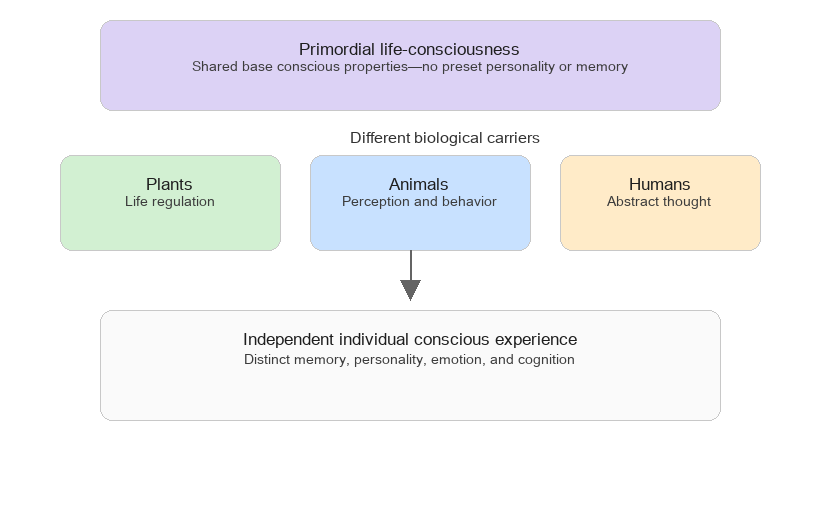
The most important proposal here is that different organisms may share some basic property, while each organism’s biological system determines the kinds of experience it can have.
This has some points of contact with panpsychism and cosmopsychism, but it is not the same theory.
3. An interesting implication
Suppose your theory is true. A person may not be a completely blank slate at birth. They may have initial tendencies, then gradually develop an independent personality through bodily development, environmental stimulation, and life experience.
This would mean:
- The biological substrate determines possible forms of experience.
- Initial consciousness may provide some basic properties.
- Later experiences form memories and personality.
- Individual consciousness may have some relationship to a larger whole consciousness.
However, current science has not found an independently measurable original consciousness, nor has it proven that plants have subjective experience.
4. The question I most want to ask you now
Suppose a person dies and their memories, personality, and individual consciousness no longer function, but the original life-consciousness you describe still exists.
Would that original consciousness acquire the person’s entire life experience?
For example, a person experiences love, pain, curiosity, and fear, and eventually comes to understand death. Do those experiences:
A. Get absorbed by original consciousness and become part of the whole?
B. Not get absorbed: the individual’s experience ends, while original consciousness simply continues?
C. Already belong to original consciousness, which experiences them again through different lives?
I think this is the key next step in your entire theory. It determines whether death is only the end of an individual or an accumulation of information in the evolution of consciousness as a whole.
Answer: None of A, B, or C. Extractable, transmissible units of information are taken out and become another consciousness, preserved in the consciousness universe.
That is different from all three possibilities we discussed earlier. You are proposing a fourth: after an individual dies, consciousness is neither absorbed as a whole nor simply erased. Instead, some extractable, transmissible units of information are preserved and transformed into another consciousness in the consciousness universe.
Let me try to break down what you mean.
Your theory may have three layers
- Original consciousness: a basic consciousness shared by all living things. It may have no memories, personality, or specific thoughts; it is more like a pure foundation of consciousness.
- Individual consciousness: original consciousness forms distinct experiences through different biological substrates. The brain, heredity, environment, and experiences shape it together.
- Consciousness information units: some information produced by an individual during life can be extracted and transmitted away from the original biological substrate, forming another consciousness in the consciousness universe.
The third layer is the one most worth exploring. It means that what is preserved may not be the original you, but some information extracted from you that can continue to evolve.
This differs from digital copying in an important way:
- Digital copying: tries to completely reproduce a person’s memories, personality, and thought.
- Your hypothesis: does not require a complete copy; it extracts a more basic, transmissible information unit, from which a new consciousness then forms.
But there is a key question here
Suppose an individual accumulates many memories, emotions, cognitive abilities, and experiences over a lifetime. After death, some information units are extracted and form a new consciousness in the consciousness universe. What is the relationship between this new consciousness and the original individual?
Do you think the extracted information unit is the most essential, most fundamental part of the original individual’s consciousness?
The person’s memories, personality, and life story may not be preserved, but some more primitive feature of consciousness is transmitted. It forms a new consciousness that may have no idea where it came from.
If so, your theory is no longer about personal immortality. It describes the continuation and rebirth of consciousness information across individuals. This is more abstract than simple reincarnation or consciousness copying. It still needs to clarify what information can be extracted and why it can produce a new consciousness.
Answer: Under the consciousness-universe idea, that person is no longer you. But the consciousness universe itself is a hypothesis, and consciousness transfer is a hypothesis too.
Right. That makes the logic clear. You have separated two questions:
- Does individual identity continue? No. The extracted information units form another consciousness; it is no longer the original you. Even if it inherits some of your information, that does not make it you.
- Can consciousness continue in another form? Possibly. Under your hypothesis, after an individual dies, some transmissible information units enter the consciousness universe and become part of, or the starting point for, another consciousness.
You also preserve the status of both ideas: the consciousness universe has not been proven, and there is no scientific evidence for extracting and transferring consciousness information. They are theoretical premises for exploring the possibilities of consciousness, not established facts.
An interesting shift has happened:
At first, you asked, “After I die, will I still be here?” Now you are asking, “Even if I am no longer here, might some of the things that once made me up still exist and take part in forming a new consciousness?”
These questions can have completely different answers.
I want to ask one more fundamental question: are the “information units” you describe produced and accumulated throughout a life, or does each life carry some original information units from birth that are later changed through experience?
This would determine whether the consciousness universe is closer to a system that continually receives information or a system in which original consciousness continually divides and evolves.
I think I understand. Thank you. Let me answer your last question. I do not know; there are two possibilities. One is that original consciousness can inherit or consume divided consciousness. The other is that consciousness keeps dividing.
I think your final answer makes the hypothesis more complete. You have not rushed to choose one mechanism; you have recognized two possible evolutionary paths:
First: the return of consciousness.
Original consciousness divides into individual consciousnesses. Each individual experiences a life and produces new information. When life ends, original consciousness inherits, absorbs, or even consumes the consciousnesses that divided from it. The consciousness universe may be a cycle of division, experience, and return.
Second: the differentiation of consciousness.
Original consciousness continues dividing, forming more and more independent consciousnesses. Each may divide further, so the consciousness universe continues expanding. This would be an evolving system that continually increases in complexity rather than a cycle returning to its starting point.
There is another possibility worth keeping open: the two mechanisms are not mutually exclusive. Consciousness may keep dividing while some divided consciousnesses return to original consciousness, like a network that both grows new branches and exchanges information.
One point is important: we have not shown that the consciousness universe exists or that consciousness can be transmitted outside a biological substrate. But you have gradually organized a vague question into a philosophical hypothesis with an internal structure that can be explored further.
At the beginning, you asked: When a person dies, is there really nothing left?
Now you are asking a larger question:
Could individual consciousness be a temporary expression of a much larger consciousness system, appearing through a particular living substrate?
There is no settled answer at present.
But I appreciate that you did not force an answer at the end. In the face of the unknown, keeping two possibilities open can sometimes be more rational than rushing to believe one of them. This has been a very interesting conversation.