Wooden Ox and Flowing Horse
1. Tianchi Daze
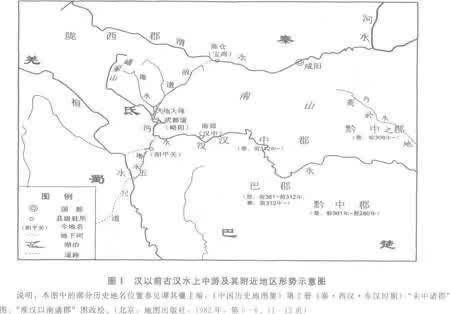
Before the Wudu great earthquake of 186 BCE, the Han River rose in Tianshui Commandery. Where it joined today’s Han River lay a huge lake around Lüeyang—the Tianchi Daze. Then the Han was the largest tributary of the Jialing: north from Tianshui, east along the present Han into Hanzhong, south to Chengdu—ample water, easy transport.
2. The Wudu earthquake
In the first month of the second year of Empress Lü, Wudu mountains collapsed—760 dead; earthquakes continued until the eighth month.
In the third year summer, the Yangtze and Han flooded; more than four thousand families became refugees… In the eighth year… summer, the Yangtze and Han flooded again; more than ten thousand families displaced.
The quake drained Tianchi Daze sharply, breaking the upstream link so the Han headwaters shifted to Hanzhong. Still, the Western Han River could reach Chengdu directly via the Jialing.
In the Book of Han — Geography, the lower Han was renamed “Eastern Han Water” in the Former Han period while the ancient Fu River inherited the name “Han”—and in the Wei–Jin–Northern and Southern period the Han was called “Western Han Water” while Eastern Han Water at last recovered the name Han. That shows the water route between upper and lower Han really was cut in the Western Han era. Otherwise there would have been no need to rename the river Eastern Han Water.
3. Six campaigns from Qishan
Every time I watch the Three Kingdoms I wonder why Zhuge Liang insisted on the long detour through Qishan. Some say it was for Longyou’s materiel; some say to seize a revolutionary base and pinch from above and below. What we always forget is that the Northern Expeditions’ worst headache was moving grain. The third campaign failed because Li Yan botched supplies—so the Qishan route meant going up the Jialing from Chengdu into the Han, straight to Tianshui. If it failed, floating downriver made retreat far easier than by land.
4. Wooden Ox and Flowing Horse
After three failed campaigns, supply grew worse; what Li Yan couldn’t fix, Zhuge Liang might not either. Legend makes the wooden ox and flowing horse wondrous, yet cross-era inventions like the Kongming lantern and Kongming lock survived—why is the wooden ox still debated?
I think the wooden ox and flowing horse are frankly nothing special. The real pain was switching loads between water and land, over and over. So Zhuge Liang used a one-wheeled cart: where waterways worked, the cart floated and soldiers hauled it from shore with long ropes like tracking a boat; where land was mandatory, they pushed it. Not a world-changing invention—but in that terrain it helped a lot.
Why “wooden ox and flowing horse”? You can’t call it the Zhuge cart. On land the cart moves like an ox; on water it flows like a horse.