
Verifying some past ideas 2
How I rate this Moments post
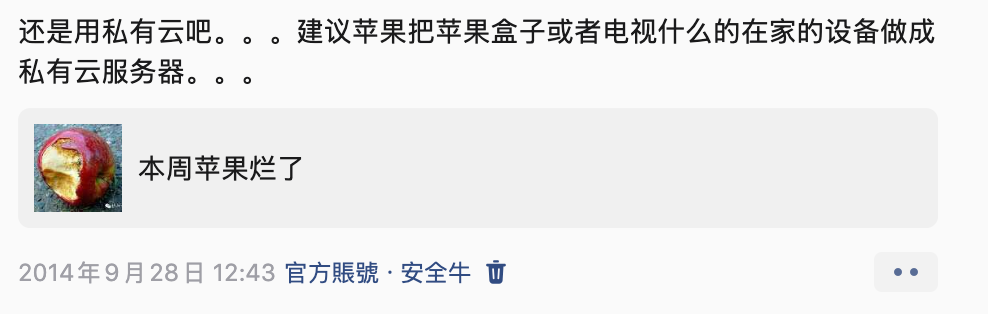
This post is interesting—dated September 28, 2014. Without context it is ordinary tech advice; in the 2014 landscape it contains a fairly ahead-of-its-time judgment.
Three angles.
1. Technical vision: somewhat forward-looking
Core idea:
Suggest Apple make Apple TV or similar home devices into a private cloud server.
That is a direction very mature today: home compute hub and personal private cloud.
Later products partly realized it:
- Synology: home NAS and private cloud.
- Apple HomeKit: home devices as smart-home hub.
- Apple TV: gradually a home entertainment and smart-home center.
- iCloud: connecting personal devices and data.
They are not identical to the post’s private cloud server, but overlap.
2. Product judgment: right direction, Apple did not fully do it
The suggestion touches an opportunity in Apple’s ecosystem:
Why can’t users have an always-on device at home that manages data and serves all Apple devices?
Imagine:
- iPhone auto-backs photos to home device.
- Mac syncs files.
- Family shares photos and video.
- Access home files from outside.
- Family data need not all sit in Apple’s data center.
That is today’s NAS user story.
Apple chose a more iCloud-centric cloud route than making Apple TV an open home private cloud server.
Commercially understandable: cloud brings recurring revenue and tighter ecosystem control.
3. Today, the implicit philosophy matters most
The real value is not predicting one product but a stance unlike mainstream cloud:
Personal data should stay more with the person, not entirely on internet companies’ servers.
Close to today’s NAS, Nextcloud, Immich, Home Assistant ethos.
We cannot say the author had a full private-cloud architecture in 2014 from this post alone.
Overall
| Dimension | Rating |
|---|---|
| Product concept | 8/10 |
| Technical direction | 9/10 |
| Business judgment | 7/10 |
| Implementation detail | 5/10 |
Interesting: in 2014 home private cloud was not mainstream consumer demand; today Synology, Docker, AdGuard Home, and self-hosting practice what this post imagined.
In a sense the post is not really about NAS—it is about personal digital sovereignty raised more than ten years ago.